






|
Water,
where life began.
Water, Whose blessing nourishes all life.
Water, That gave birth and nurtured civilizations.
Water,
A symbol of serene beauty.
Cascading
water that dances in exuberance.
Flowing water that knows no stagnation.
Rushing water that cares not for obstacles in its path.
Still water that runs great depths.
Gentle water of quiet strength that destroys iron,
of perseverance that smoothens rough rocks.
Such
too is the strength and beauty of the Bhagavad Gita – the
divine song – that makes its presence felt – slowly, surely
and deeply.
The
School of Bhagavad Gita
is the nucleus of the ashram.
The
Bhagavad Gita is the divine discourse delivered by the Lord Sri
Krishna to Arjuna in the battlefield of Kurukshetra. It consists
of 18 chapters and 701 slokas and occurs in the Bheeshma Parvam
of the Mahabharata. Hailed universally as one of the greatest
spiritual books that the world has known, it explains the means
to realize and maintain the eternal relationship with the
Supreme. The uniqueness of the Gita is that it is equally
applicable to all of humankind and is totally non-sectarian.
THE
PERCEPTION
The
School
of
Bhagavad Gita
stands for the universality of the Gita. It is rooted in the
belief that the Gita is within everyone’s potential reach and
envisions to make it a part of everyday life. To quote Swami Sandeepananda Giri: “Like sunrise and sunset, the presence
of the Gita must become part of day to day life – strong, yet
unobtrusive.”
“The
Gita is a hand-book of instructions as to how every human being
can come to live the subtle philosophical principles of Vedanta
in the actual work-a-day world… Religion is philosophy in
action. From time to time an ancient philosophy needs
intelligent re-interpretation in the context of new times, and
men of wisdom, prophets, and seers guide the common man on how
to apply effectively the ancient laws in his present life.”
- Swami Chinmayananda
The
Bhagavad Gita draws inspiration from the sacred Indian
scriptures, especially the Upanishads and contains their
essence. At the same time, the Gita itself has provided the
inspiration for the creation of a number of other
texts—versions and original. The School of Bhagavad Gita
aims to pioneer the comprehensive and comparative study of all
such related literature.
The
Gita has cast stupendous influence on world leaders, thinkers,
scientists and freedom fighters. The School will undertake a
systematic and authoritative study and documentation of this
impact.
“The
Gita is the universal mother…There was never a man who
worshipped her in this spirit and went back disappointed. I find
solace in the Bhagavad Gita…When disappointment stares me in
the face and all alone I see not one ray of light, I go back to
the Bhagavad Gita. I find a verse here and a verse there, and I
immediately begin to smile in the midst of overwhelming
tragedies-and if they have left no visible, no indelible scar on
me, I owe it all to the teaching of the Bhagavad Gita” -
Mahatma Gandhi
The
strength of the Gita lies in its appropriateness at all times,
all situations and to all sections of people everywhere. The
School has undertaken the publication of the Gita meant for
children, the sick and elderly, the youth and so on.
“A
mighty spirit moves through the pages of the Bhagavad-Gita. It
has the seductive influence of beauty; yet, like strength, it
fills one as with the sound of armies assembling or the roar of
great waters. Appealing alike to the warrior and the
philosopher, it shows to the one the righteousness of lawful
action, and to the other the calmness which results to him who
has reached inaction through action.” - William Q. Judge.
1890
Prabhashanam-
Discourses and Lectures
The
School hosts and conducts discourses by visiting scholars from
all parts of the world. It will create opportunities for
interaction and co-operation between Western and Indian scholars
on the Gita, Vedas, Upanishads, Indian philosophy and related
topics.
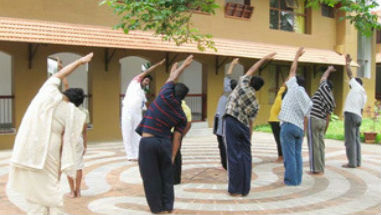
Sadhana-
Retreats and Camps, Pilgrimages
Retreats
that provide the opportunity to experience monastic lifestyle
and to cultivate the mind and body are part of the School’s
agenda. Educative camps for the young and old, with programmes
that include meditation, yoga, cultural activities and
entertainment, besides study classes are a regular feature.
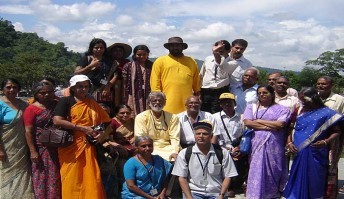
Spiritual journeys and pilgrimages that help in appreciating the
country’s historic, cultural and spiritual heritage are
conducted round the year. Participation is open to all citizens
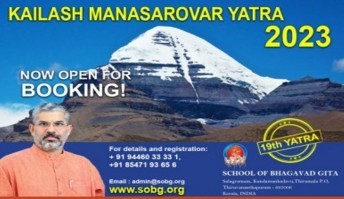
from home and abroad. The Kailas-Mansarovar
yatra, and the Kurukshetra-Haridwar-Hrishikesh camp, to name a few, have generated extensive participation.
Off-Campus
Programmes
Yagnas,
lectures and study classes under the guidance of Swami Sandeepananda Giri will be conducted at regular intervals in all parts of
the globe. The school takes up discourses, mantra chanting and
similar programmes for therapeutic treatments in hospitals,
jails and rehabilitation centers.
Other
Infrastructure
Infrastructure
facilities of the School include accommodation amenities,
meditation hall, and classrooms with audio-visual facilities,
restaurants and conference hall. A theatre equipped with
state-of-the art technology will be a notable feature of the
complex, where viewers will view cinema interactively. It
creates an exciting environment of infotainment, enhancing and
enriching one’s awareness of the country’s heritage.
Saamskarikam-
culture center
The
cultural center is envisioned to be the forum that can nourish
the ongoing exploration of Indian culture. Through the medium of
art forms-performing as well as literary- the center encourages
institutions and individuals to interpret and disseminate
aspects of Indian history, culture, traditions and contributions
in the context of the past, present and future. The center is
thus a multi-purpose, multidisciplinary facility that provides a
platform for such cultural activities with the participation of
artists, intellectuals, students, citizens and audiences. It is
a centre, which welcomes all who are interested in art, music
and the humanities, a place, which affords plenty of activities
for the mind and for the senses.
ADMINISTRATION
TheSchool
of
Bhagavad Gita is registered as a non-profit, public charitable trust.
The
School
of
Bhagavad Gita Trust
with a dedicated team will oversee the implementation of the
projects under the ashram. The Salagramam ashram and the School
will be under the able guidance and directorship of Swami Sandeepananda Giri. |